
Exploring the Choice Between Relational and Non-Relational Databases
Understanding the distinctions between relational and non-relational databases and their implications for developers.
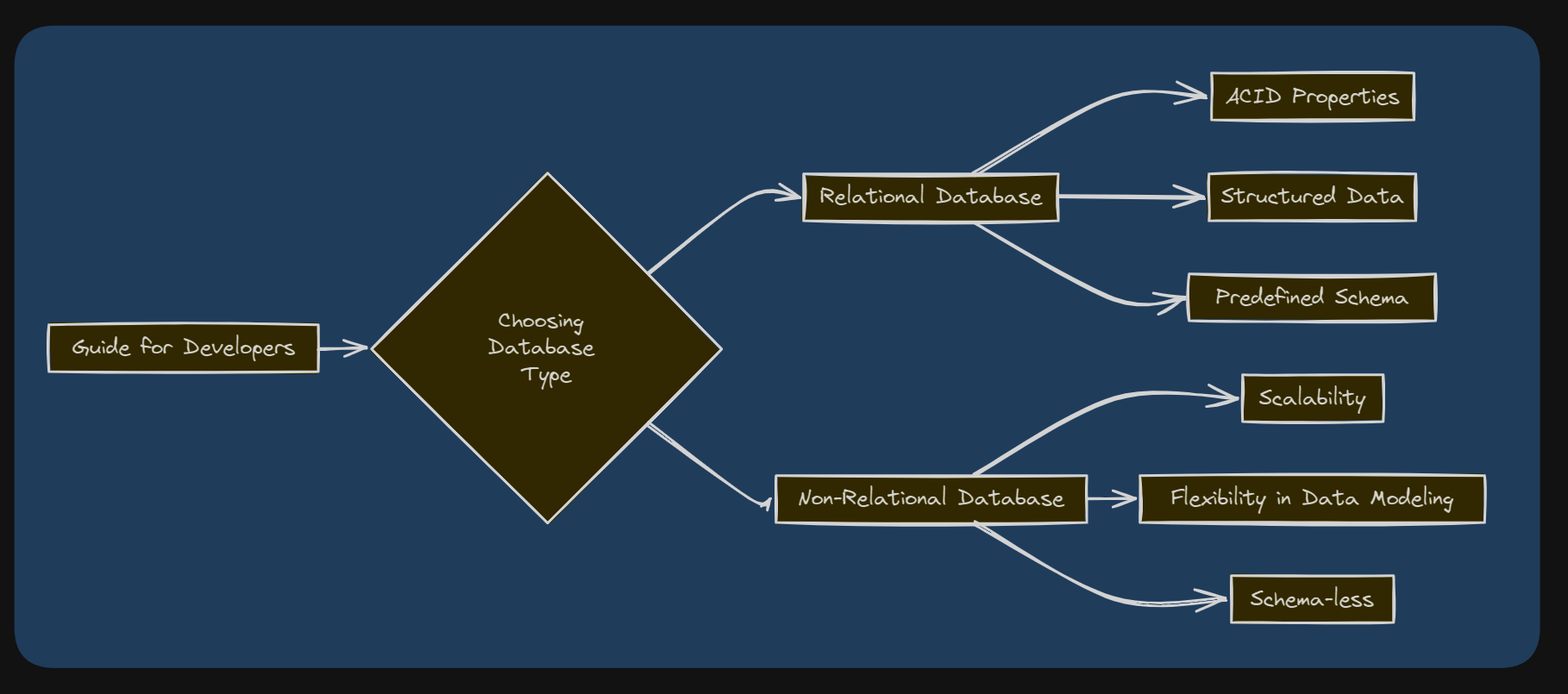
Relational Databases: Structured and Time-Tested
Relational databases have been the cornerstone of data management for decades. They organize data into structured tables with predefined schemas, where relationships between different datasets are maintained through keys.
Key Characteristics:
- Structured Data: Data is organized into tables with rows and columns, ensuring data integrity and consistency.
- ACID Compliance: Transactions adhere to the ACID (Atomicity, Consistency, Isolation, Durability) properties, guaranteeing reliability and robustness.
- Complex Queries: SQL allows for complex queries involving multiple tables, enabling sophisticated data analysis.
Non-Relational Databases: Flexible and Scalable
Non-relational databases, also known as NoSQL databases, emerged to address the limitations of relational databases, particularly in handling large volumes of unstructured or semi-structured data.
Key Characteristics:
- Schemaless Design: Unlike relational databases, NoSQL databases do not enforce a rigid schema, allowing for dynamic and evolving data structures.
- Horizontal Scalability: Non-relational databases excel in distributed environments, enabling seamless scaling across clusters of servers.
- Variety of Data Models: NoSQL databases support various data models, including document-based, key-value, and graph-based, catering to different use cases.
Choosing Between Relational and Non-Relational Databases
The decision between relational and non-relational databases hinges on several factors, including the nature of the data, the scalability requirements, and the development team's familiarity with the technology stack.
When to Choose Relational Databases:
- Structured Data: If your data has a well-defined schema and requires ACID compliance, relational databases are a natural choice.
- Complex Queries: For applications that demand complex querying and relational integrity constraints, such as financial systems or e-commerce platforms, relational databases offer robust solutions.
When to Choose Non-Relational Databases:
- Unstructured or Semi-Structured Data: When dealing with diverse data types or unpredictable schemas, NoSQL databases provide the flexibility needed to adapt to changing requirements.
- Scalability: If your application anticipates rapid growth or operates in a distributed environment, non-relational databases offer horizontal scalability without sacrificing performance.
Code Example: Choosing Between MongoDB and MySQL
Let's consider a scenario where we need to store user data for an e-commerce platform.
CREATE TABLE Users (
    UserID INT PRIMARY KEY,
    Username VARCHAR(50),
    Email VARCHAR(100),
    ...
);
However, if the platform aims to handle a vast amount of user-generated content, such as product reviews and recommendations, and requires flexible schema design, MongoDB, a document-based NoSQL database, might be a better fit:
db.users.insertOne({
    username: "exampleUser",
    email: "user@example.com",
    ...
});
Conclusion
In conclusion, the choice between relational and non-relational databases depends on various factors, including data structure, scalability requirements, and project complexity. Understanding the strengths and weaknesses of each type is essential for building robust and efficient database solutions that align with the project's objectives.
Whether you opt for the structured elegance of relational databases or the flexible scalability of non-relational databases, make sure to evaluate your specific use case carefully to make the right decision.
4 min read
back to blog