
Exploring the Fundamentals: Linear Search Demystified
Learn about the linear search algorithm, a fundamental searching technique in computer science, and its implementation in JavaScript.
Introduction
Learning about algorithms is something very unique, especially the ones that form the backbone of so many applications we use daily. Today, I want to delve into one of the simplest yet foundational searching algorithms: the Linear Search.
Understanding Linear Search
Imagine you're in a library trying to find a particular book among hundreds stacked on the shelves. How would you go about it? You'd probably start from one end, scanning each book until you find the one you seek. Congratulations, you've just performed a linear search!
In the world of programming, a linear search is akin to this process. It's a straightforward method of finding a target value within an array or list by sequentially checking each element until a match is found or the entire list is traversed.
Implementation in JavaScript
Let's dive into some JavaScript code to illustrate this concept:
function linearSearch(arr, target) {
    for (let i = 0; i < arr.length; i++) {
        if (arr[i] = target) {
            return i; // Return the index if target is found
        }
    }
    return -1; // Return -1 if target is not found
}

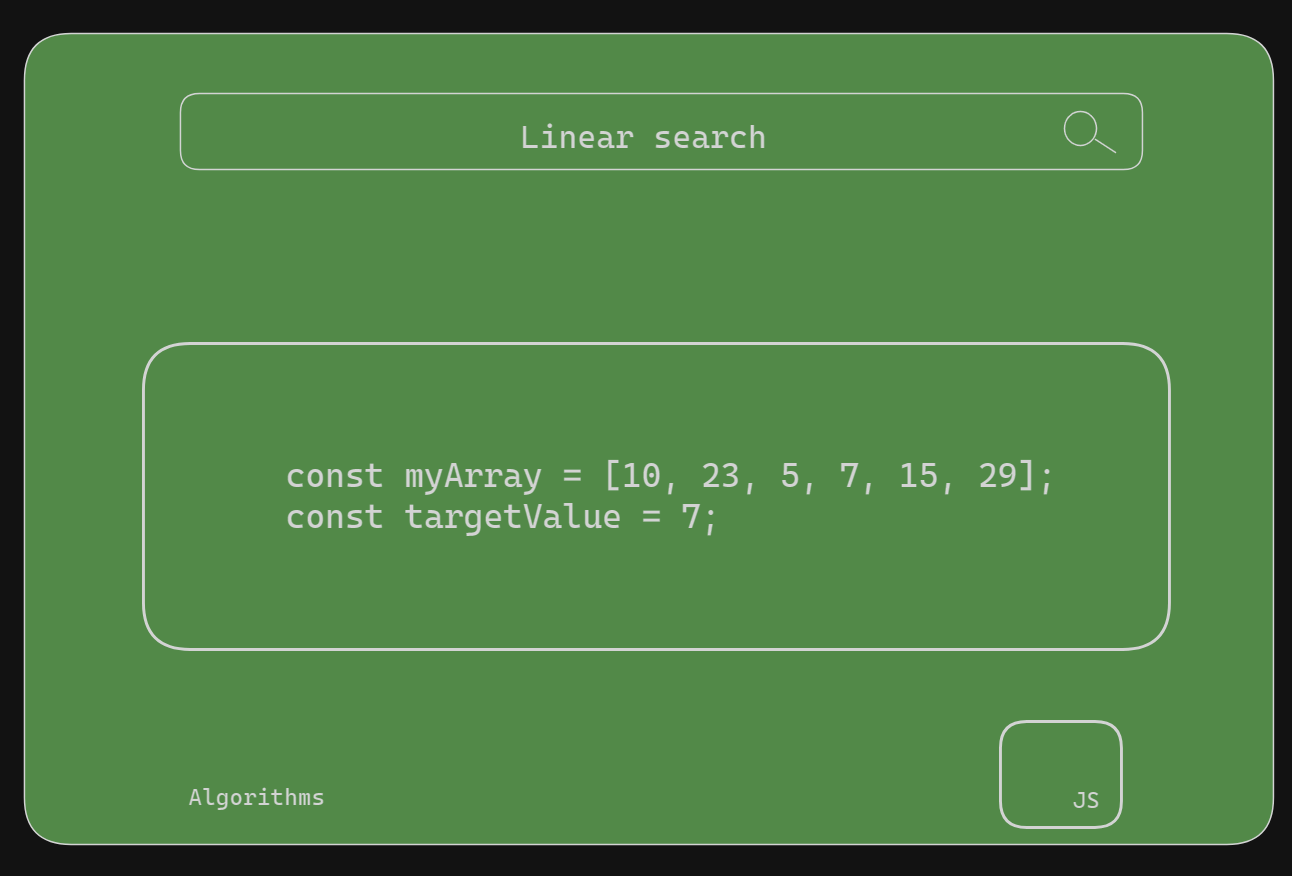
const myArray = [10, 23, 5, 7, 15, 29];
const targetValue = 7;

const resultIndex = linearSearch(myArray, targetValue);
if (resultIndex !== -1) {
    console.log(Found ${targetValue} at index ${resultIndex});
} else {
    console.log(${targetValue} not found in the array);
}
In this example, we define a linearSearch function that takes an array (arr) and a target value (target). We iterate through each element of the array using a loop, comparing each element with the target value. If we find a match, we return the index of that element. If no match is found after traversing the entire array, we return -1.
Time Complexity Analysis
Now, let's analyze the time complexity of the linear search algorithm. In the worst-case scenario, where the target element is not present in the array or is at the last position, we have to traverse all elements. Thus, the time complexity of linear search is O(n), where n is the number of elements in the array.
Conclusion
Although linear search is not the most efficient searching algorithm, it serves as a fundamental building block for more complex algorithms and is useful in scenarios where the data is small or unordered.
In conclusion, while linear search may seem basic, it's an essential concept to grasp for any developer. Understanding its simplicity lays a solid foundation for comprehending more advanced searching algorithms and fosters a deeper appreciation for the elegance of problem-solving in the world of programming.
3 min read
back to blog